
Pupil Voice and Perspectives on Internal Exclusion: Can Internal Exclusion Units be both restorative and reflective?
Who
- Researcher
- James Kelly
- Degree
- PGT
- Programme
- PGCE Secondary Geography
- Keywords
-
Beliefs Secondary Student Survey
- Methods
-
Qualitative
- Categories
-
Education & language
Summary
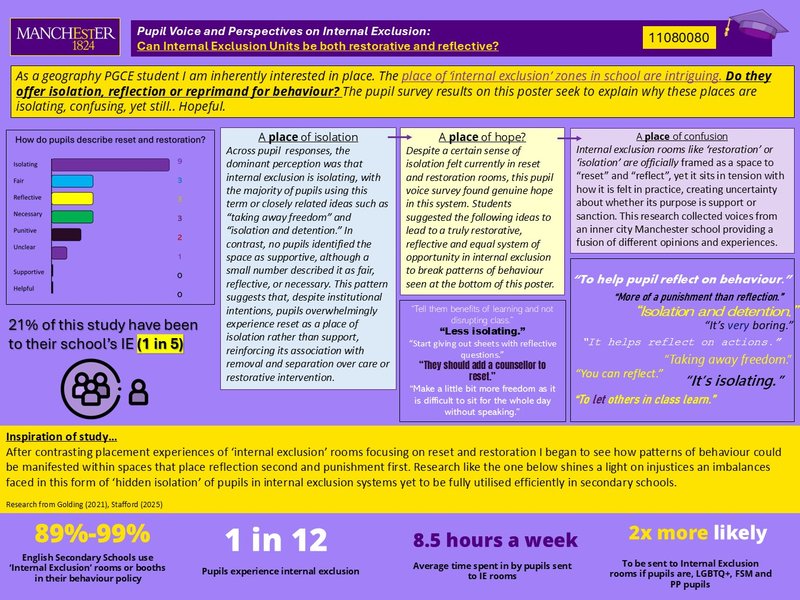
As a geography PGCE student I am inherently interested in place. The place of ‘internal exclusion’ zones in school are intriguing. Do they offer isolation, reflection or reprimand for behaviour? Internal exclusion rooms like ‘restoration’ or ‘isolation’ are officially framed as a space to “reset” and “reflect”, yet it sits in tension with how it is felt in practice, creating uncertainty about whether its purpose is support or sanction. This research collected voices from an inner city Manchester school providing a fusion of different opinions and experiences. Despite a certain sense of isolation felt currently in reset and restoration rooms, this pupil voice survey found genuine hope in this system. Students suggested hopeful ideas to lead to a truly restorative, reflective and equal system of opportunity in internal exclusion to break patterns of behaviour seen in recent research and experiences gathered so far in this field.Across pupil responses, the dominant perception was that internal exclusion is isolating, with the majority of pupils using this term or closely related ideas such as “taking away freedom” and “isolation and detention.” In contrast, no pupils identified the space as supportive, although a small number described it as fair, reflective, or necessary. This pattern suggests that, despite institutional intentions, pupils overwhelmingly experience reset as a place of isolation rather than support, reinforcing its association with removal and separation over care or restorative intervention. This practitioner enquiry explores pupil perspectives on internal exclusion in a secondary school, asking whether internal exclusion units can function as genuinely restorative and reflective spaces rather than simply punitive sanctions. While internal exclusion has become an increasingly common feature of behaviour management in English secondary schools, there is limited research examining how pupils themselves experience these environments. The study was conducted within an inner-city Catholic secondary school in Manchester using a mixed-methods approach. Fourteen Year 9 pupils completed questionnaires comprising Likert-scale and open-ended questions, supplemented by informal class discussions and reflective field notes. This methodology enabled both quantitative analysis of pupil perceptions and qualitative exploration of their lived experiences. The findings reveal a clear disconnect between the intended purpose of internal exclusion and pupils' experiences. Pupils who had not experienced internal exclusion generally viewed reset and restoration rooms positively, describing them as opportunities for reflection and behaviour improvement. In contrast, pupils with direct experience were more likely to characterise these spaces as punitive, isolating and emotionally disengaging. Although most pupils recognised the need for behaviour management, they consistently advocated for greater emphasis on reflection, counselling, dialogue and emotional support rather than silent compliance. The enquiry argues that current internal exclusion practices often prioritise classroom order over meaningful restorative engagement, particularly for pupils with SEND and SEMH needs, who are disproportionately affected by exclusionary practices. Drawing on literature surrounding restorative practice, inclusion and pupil voice, the study highlights the importance of embedding meaningful opportunities for dialogue and participation within behaviour systems. Overall, the research concludes that internal exclusion can only become genuinely restorative if schools move beyond punitive models of isolation and actively involve pupils in shaping reflective processes. Greater emphasis on pupil voice, relational practice and emotional support has the potential to improve behaviour outcomes while creating more inclusive behaviour systems that better align with the restorative principles schools increasingly seek to promote.
Impact
After contrasting placement experiences of ‘internal exclusion’ rooms focusing on reset and restoration I began to see how patterns of behaviour could be manifested within spaces that place reflection second and punishment first. Research like the one attempted here, shines a light on injustices and imbalances faced in this form of ‘hidden isolation’ of pupils in internal exclusion systems yet to be fully utilised efficiently in secondary schools. While schools frequently justify internal exclusion as necessary for maintaining classroom order and protecting learning environments, the evidence supporting its long-term effectiveness remains limited (Condliffe, 2023). Existing literature has raised concerns regarding both pupil wellbeing and the disproportionate application of removal practices among vulnerable groups, including pupils with Special Educational Needs and Disabilities (SEND), those from disadvantaged backgrounds and some minority ethnic groups (AEP, 2018; Condliffe, 2023). Furthermore, spaces described as “safe rooms” or “reflection rooms” often lack consistency in purpose and implementation, resulting in significant variation between schools (Paterson et al., 2011; Condliffe, 2023). Alongside concerns, little research has focused directly on pupil perceptions of internal exclusion practices (Sealy et al., 2021). Much of the existing discourse surrounding behaviour systems prioritises institutional effectiveness and classroom control, often overlooking how pupils themselves interpret these interventions. Therefore, this pupil voice enquiry seeks to explore pupil perspectives on internal exclusion through questionnaires and pupil discussion. This was done in an inner-city Manchester school through discussion and a survey form with a Year 9 form, offering experiences of IE halfway through pupils journey in school. In doing so, the study aims to examine whether pupils perceive these spaces as punitive, reflective or restorative, while also considering how internal exclusion practices may be adapted to better support inclusion, reflection and relational behaviour approaches within secondary schools.
Additional information
How to cite
- Access the project on Figshare at DOI 10.48420/33278175.
- Click the red Cite button.
- Select the preferred citation style.
- Click the Copy citation hyperlink to copy the generated citation.