
How do Post-16 BTEC Business Students Negotiate the Boundary Between AI-Supported Learning and Academic Misconduct?
Who
- Researcher
- Georgia Martindale
- Degree
- PGT
- Programme
- PGCE Secondary
- Keywords
-
Beliefs Focus group Secondary Student Survey
- Methods
-
Mixed method
- Categories
-
Education & language Digital
Summary
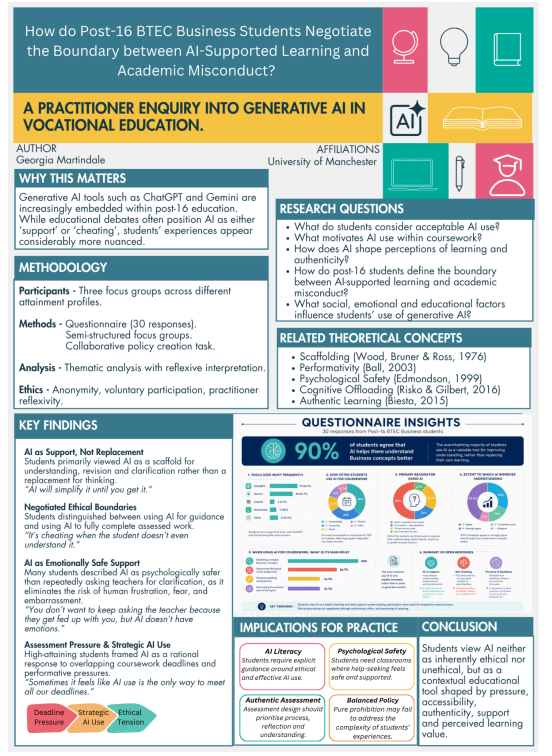
This project explored how post-16 students studying BTEC Business use Artificial Intelligence (AI) in their learning and where they believe the line lies between acceptable support and academic cheating. As AI tools such as ChatGPT and Gemini become increasingly common in education, teachers and colleges are faced with important questions about how these technologies should be used fairly while still ensuring that students develop the knowledge and skills they need. Rather than focusing on whether AI is simply "good" or "bad", this study aimed to understand students' own views and experiences so that future guidance and teaching can better reflect the reality of modern classrooms. The project involved 30 post-16 vocational Business students completing an anonymous questionnaire about their AI use, attitudes and experiences. This was followed by three focus groups involving students from different attainment backgrounds, including high-attaining Year 12 students, mixed-ability Level 2 students, and lower-to-middle attaining Year 12 students. During the focus groups, students discussed a range of scenarios involving AI before working together to create their own "acceptable AI use" policy for vocational education. Combining questionnaires with group discussions allowed the research to gather both broad trends and more detailed insights into students' thinking. The findings showed that students generally do not see AI as either completely acceptable or completely dishonest. Instead, they judge its use based on why it is being used and how much it contributes to the final piece of work. Most students believed that using AI to explain difficult concepts, generate ideas, improve understanding or help structure assignments was appropriate. However, they consistently viewed copying AI-generated work or allowing AI to complete assignments without genuine understanding as cheating. Students also recognised that relying too heavily on AI could reduce important skills such as critical thinking, independent research and problem solving. These findings closely reflect existing educational research, which suggests that AI can act as a valuable learning tool when used to support understanding, but also creates challenges for academic integrity and authentic assessment. The study also supports recent literature showing that students often use AI because of workload, deadline pressure and accessibility, rather than simply to avoid work. An additional finding was that many students felt AI provided a psychologically safe space to ask questions repeatedly without fear of judgement, highlighting an area that has received growing attention within educational research. Overall, the project concludes that banning AI completely is unlikely to be effective. Instead, schools and colleges should focus on teaching students how to use AI responsibly and ethically. The findings recommend developing clear guidance on acceptable AI use, improving students' AI literacy, designing assessments that encourage authentic learning, and creating classroom environments where students feel confident asking teachers for help without embarrassment. These approaches are more likely to prepare students for both further education and the modern workplace, where AI is expected to become an increasingly important part of everyday life.
Impact
This research addresses an important and increasingly relevant issue within post-16 vocational education: the rapid growth of Artificial Intelligence (AI) in student learning without clear, shared understanding of what constitutes appropriate or inappropriate use. Within the sixth form college where this study took place, AI use had become commonplace among BTEC Business students, yet conversations with learners suggested uncertainty around the ethical boundaries between using AI as a learning aid and using it in ways that undermine academic integrity. Existing policies focused largely on preventing misconduct but provided limited guidance on how students could use AI responsibly to support their learning. This created a need for evidence that reflected students' own experiences and perspectives, rather than assumptions about why they use AI. The knowledge generated by this enquiry provides the college with a more nuanced understanding of how students actually perceive AI. Rather than viewing AI as simply a tool for cheating, students described using it to improve understanding, clarify complex concepts, manage workload and access personalised support. At the same time, they recognised clear ethical boundaries, identifying direct copying, overreliance and submitting AI-generated work as unacceptable. These findings challenge simplistic approaches based solely on prohibition and instead demonstrate the need for explicit AI literacy, ethical guidance and assessment practices that promote genuine learning while acknowledging the reality of emerging technologies. The impact of this study extends beyond the Business department. The findings can inform the development of whole-college AI policies, staff professional development and curriculum planning, ensuring that students are taught how to use AI responsibly rather than simply being discouraged from using it. The research also highlights the importance of creating psychologically safe classrooms where students feel confident asking questions without fear of judgement, reducing unnecessary reliance on AI for support. Ultimately, this study contributes to a more balanced and evidence-informed approach to AI in education, helping educators prepare students for further study, employment and lifelong learning in a society where AI will continue to play an increasingly significant role.
Additional information
How to cite
- Access the project on Figshare at DOI 10.48420/33278190.
- Click the red Cite button.
- Select the preferred citation style.
- Click the Copy citation hyperlink to copy the generated citation.