
How do pupils perceive the role of pair work in developing confidence when speaking the target language?
Who
- Researcher
- Emily May Wadsworth
- Degree
- PGT
- Programme
- PGCE Secondary Modern Languages
- Keywords
-
Beliefs Focus group Secondary Student Survey
- Methods
-
Mixed method
- Categories
-
Education & language
Summary
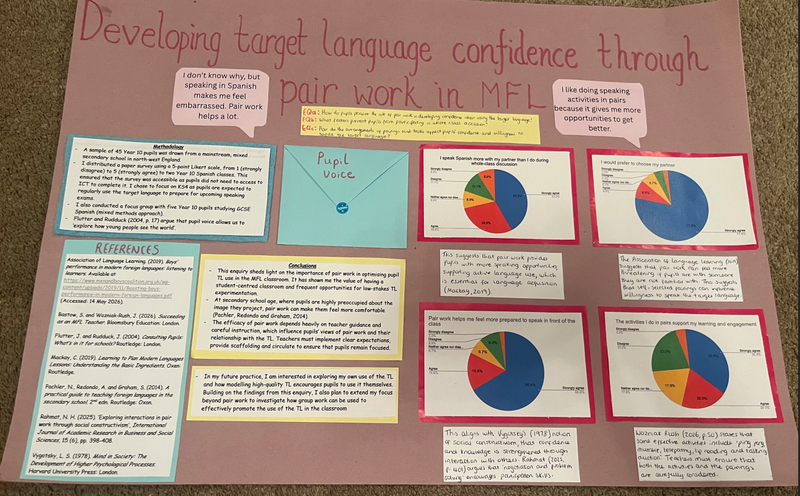
This research examines how pupils perceive the role of pair work in developing confidence when speaking the target language (TL) in Modern Foreign Languages (MFL). More specifically, I investigate the attitudes of Year 10 GCSE Spanish pupils towards paired speaking activities and how frequent practice can influence their confidence to communicate in Spanish. This enquiry also explores the factors that may prevent pupils from participating in whole class discussion and from responding in Spanish in front of their peers and class teacher. For example, I consider how teacher-selected versus student-selected pairs can influence pupils’ relationship with the TL. If successfully managed by the teacher, pair work creates a low-risk environment for pupils to experiment with the TL. As Driscoll, Macaro and Swarbrick (2014, p. 178) argue, ‘there is often an imbalance in TL use between teachers and pupils’. The regular incorporation of pair work creates a better ratio of pupil talking opportunity and a more collaborative approach. McLeod (2025) and Rahmat (2025) both agree that learning is a social process, as learners develop knowledge and confidence through interaction. Pair work increases pupils’ use of the TL not only by providing more opportunities for speaking practice, but also by encouraging social interaction and collaborative learning. I focus on two Key Stage Four classes in a mixed state school in Blackburn, where the development of pupil TL use has been identified as a priority due to upcoming speaking exams. My findings contribute to the literature on pair work in MFL and are endorsed by pupils that have first-hand experience. Driscoll, Macaro and Swarbrick (2014) argue that learner-learner interaction is beneficial for all pupils, regardless of attainment level. My study explores this further, exploring pupils’ views on pair work specifically and how teachers can utilise pair work to enhance pupils' confidence with speaking the TL. I adopted a mixed methods approach for this project, combining broader quantitative data with the depth and nuance of qualitative responses. A sample of 45 pupils was drawn from a mainstream, mixed secondary school in north-west England. Participants are in Year 10 and therefore aged 14-15 years old. I first distributed a paper survey using a 5-point Likert scale, from 1 (strongly disagree) to 5 (strongly agree) to two Year 10 Spanish classes. A focus group was also conducted with five year 10 pupils studying GCSE Spanish, selected due to availability. I used pie charts to allow me to examine pupils’ responses to each question. The qualitative research was analysed using thematic coding to identify themes and recurring patterns. After collecting responses from the interviews, comments were grouped into categories such as confidence, fluency, anxiety, enjoyment, and peer support. This enquiry sheds light on the importance of pair work in optimising pupil TL use in the MFL classroom. It has shown me the value of having a student-centred classroom and frequent opportunities for low-stakes TL experimentation. My findings demonstrate that pair work is an effective strategy in maximising pupil TL use.
Impact
This research addresses a key need within the MFL classroom: increasing pupils' confidence and willingness to communicate in the target language. At secondary school age, where pupils are highly preoccupied about the image they project, pair work can make them feel more comfortable (Pachler, Redondo and Graham, 2014). From my research, it has become evident just how much anxiety and fear of making mistakes can affect the quality and quantity of pupil TL use. Pair work is effective because it contributes to more fruitful whole-class discussion later, as pupils can rehearse vocabulary and develop fluency, in turn building confidence and enjoyment. By reducing the fear of making mistakes, structured pair work contributes to the development of pupils’ self-efficacy as language learners. My findings suggest that pupils are often more willing to contribute verbally when working alongside a peer rather than speaking in front of the whole class, as pair work reduces the pressure associated with making mistakes publicly (Aulia, Lengkanawati and Rodliyah 2019). These ideas are linked to Vygotsky’s (1978) social constructivist theory, as pair work allows pupils to learn collaboratively, supporting each other within their zone of proximal development. This study has practical value for both the school and the wider teaching community. It highlights that the efficacy of pair work depends heavily on teacher guidance and careful instruction, which influence pupils’ views of pair work and their relationship with the TL. Teachers must implement clear expectations, provide scaffolding and circulate to ensure that pupils remain focused. Regarding my future practice, I intend to investigate whether similar principals can be applied to group work to further promote use of the target language in the classroom.
Additional information
How to cite
- Access the project on Figshare at DOI 10.48420/33278166.
- Click the red Cite button.
- Select the preferred citation style.
- Click the Copy citation hyperlink to copy the generated citation.