
A Qualitative Pupil Voice Enquiry into Routine, Engagement and Independence in Year 10 Business Lessons
Who
- Researcher
- Isha Sadiq Haider
- Degree
- PGT
- Programme
- PGCE Secondary Business Studies
- Keywords
-
Beliefs Focus group Mainstream Secondary Survey
- Methods
-
Mixed method
- Categories
-
Education & language
Summary
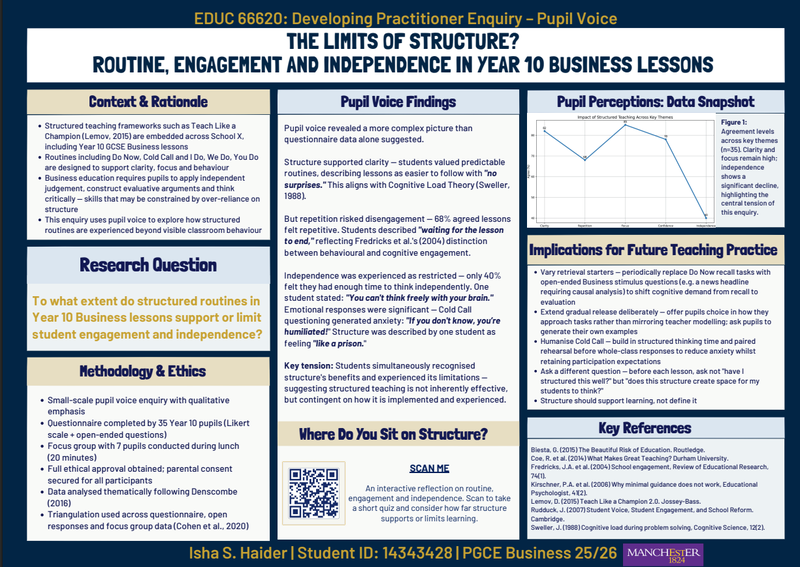
This project explored how structured classroom routines affect Year 10 pupils’ engagement and independence in GCSE Business lessons. The enquiry began because routines such as “Do Now” activities, teacher modelling, guided practice and Cold Call questioning appeared to help pupils settle quickly, understand expectations and work with focus. However, Business also requires pupils to compare options, justify decisions and form independent judgements. I therefore wanted to understand whether highly structured lessons supported these skills or sometimes limited them. The study involved two Year 10 Business classes in a secondary school in Manchester. Thirty-five pupils completed an anonymous questionnaire containing both rating-scale and open-ended questions. The questions explored clarity, focus, confidence, repetition, thinking time and independence. Seven pupils then took part in a twenty-minute focus group so that they could explain their views in more detail. Ethical approval was secured before the research began, parents were informed, and all pupil and school details were anonymised. The findings showed that pupils experienced structure in two contrasting ways. Many pupils valued clear explanations, step-by-step examples and predictable routines because these reduced confusion and made lessons easier to follow. Eighty-two per cent agreed that structure helped them understand lessons, while eighty-five per cent said it helped them stay focused. These findings support existing evidence that clear guidance can reduce unnecessary mental demand, especially when pupils are learning unfamiliar terminology and concepts. At the same time, sixty-eight per cent of pupils felt that lessons could become repetitive, and only forty per cent felt that they had enough time to think independently. In the focus group, some pupils described lessons as “the same every lesson”, said they were “waiting for the lesson to end”, or felt that they could not “think freely”. Some also described embarrassment when they were asked questions publicly without enough preparation time. The main conclusion was that structure can act as both a scaffold and a ceiling. It supports learning when it reduces uncertainty and helps pupils access difficult content, but it can become limiting when it controls the pace or direction of thinking too closely. The project therefore recommends a more balanced approach: provide clear explanation and modelling, allow guided rehearsal, then deliberately reduce support so that pupils can make decisions and construct their own responses. It also recommends giving pupils thinking time or paired rehearsal before public questioning and using regular pupil feedback to check whether classroom routines are supporting or restricting learning.
Impact
The school context addressed by this enquiry was one in which structured teaching routines were widely used to support behaviour, clarity and lesson consistency. These routines were valuable, particularly for pupils who benefited from predictable expectations and step-by-step guidance. However, the research identified a further need: pupils also required more variety, thinking time, emotional safety and opportunities to make independent decisions. The knowledge generated by the enquiry is useful because it shows that visible participation does not always mean genuine engagement. A pupil may be quiet, complete the task and appear focused while still feeling bored, restricted or anxious. This is especially important in Business education, where pupils must do more than follow a model. They need to compare alternatives, apply evidence and justify their own conclusions. The study will influence my classroom practice by changing how I use structure. I will keep routines that provide clarity, but vary the thinking required within them. Retrieval starters will sometimes include business headlines, stakeholder dilemmas or short evaluative questions rather than factual recall alone. I will also reduce scaffolding more deliberately, moving from full teacher models to partial guidance and then to pupil-generated responses. The findings will also shape my use of questioning. For demanding questions, pupils will receive silent thinking time, paired rehearsal or mini-whiteboard practice before being asked to answer publicly. This should retain participation while reducing avoidable embarrassment. I will also use brief pupil-voice questions to check when lesson structure has helped or limited pupils’ thinking. The wider impact is a more responsive approach in which structure is used as a temporary route towards independence, rather than as a fixed lesson format. The poster communicates the same practical recommendations: varying retrieval, extending gradual release, humanising Cold Call and ensuring that structure creates space for pupils to think.
Additional information
How to cite
- Access the project on Figshare at DOI 10.48420/33278169.
- Click the red Cite button.
- Select the preferred citation style.
- Click the Copy citation hyperlink to copy the generated citation.