
“Our doubts are traitors”: Investigating Students’ Experiences of Studying Shakespearean Drama
Who
- Researcher
- Olivia North
- Degree
- PGT
- Programme
- PGCE Secondary English
- Keywords
-
Beliefs Focus group Mainstream Secondary Survey
- Methods
-
Mixed method
- Categories
-
Education & language
Summary
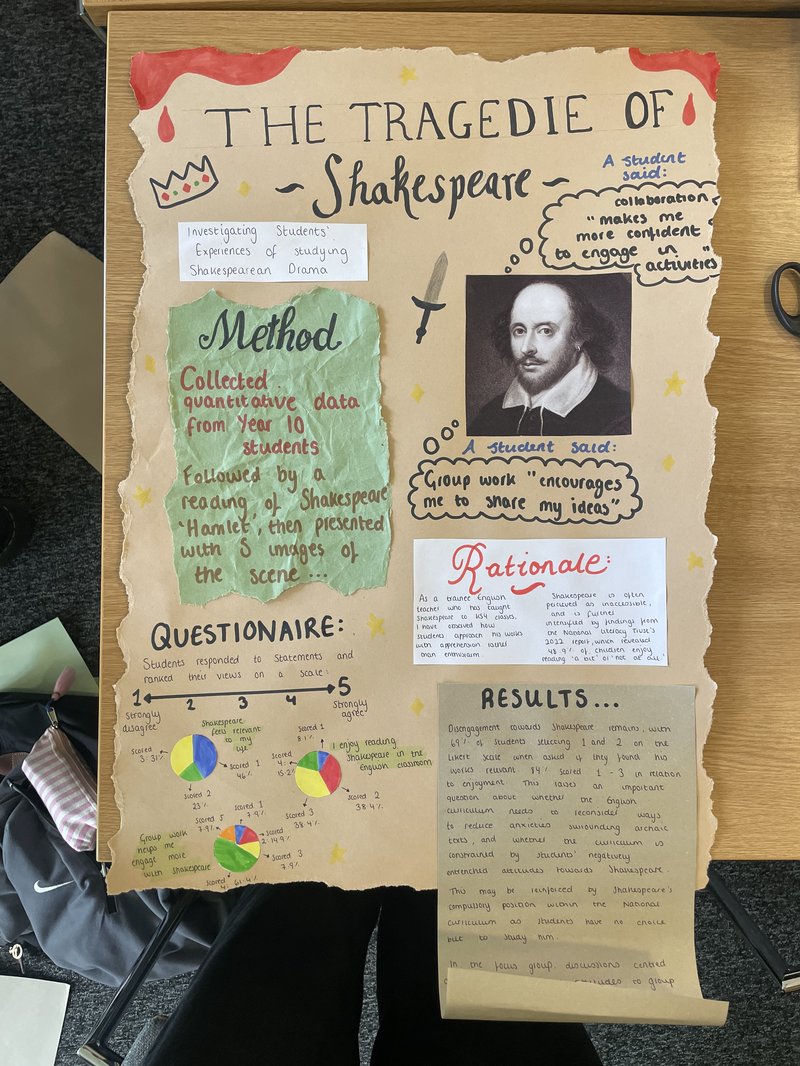
This project explored how Year 10 students experience studying Shakespeare in English lessons and investigated whether more active and creative teaching approaches could improve their understanding, and engagement. Shakespeare remains the only compulsory author in the English National Curriculum, yet many students find his language and themes difficult to access. The aim of this study was to better understand students' perspectives and identify teaching strategies that make Shakespeare feel more meaningful and enjoyable. The research was carried out in a selective independent secondary school with 12 Year 10 students who were studying for their GCSEs. The study used a combination of questionnaires and a focus group to gather students' views. First, all 12 students completed a questionnaire containing nine rating-scale questions about their experiences of learning Shakespeare, along with an opportunity to explain one of their answers in more detail. Six students were then randomly selected to take part in a focus group. During this session, they explored Act 3, Scene 1 of Hamlet through a creative poster-making activity using images alongside the text before taking part in a group discussion about their ideas and experiences. The findings showed that students responded positively to teaching methods that encouraged collaboration and creativity. Most students felt that group work, film or stage adaptations, modern-day connections, and creative activities such as drawing and poster-making helped them understand Shakespeare better and gave them greater confidence to share their ideas. Many students explained that seeing the plays performed or represented visually made the language easier to understand and helped them connect with the characters and themes. However, the study also found that many students still did not particularly enjoy studying Shakespeare or see his work as relevant to their own lives. Although active learning approaches increased engagement and confidence, they did not completely overcome students' negative attitudes towards Shakespeare. These findings reflect existing research, which suggests that performance-based and collaborative teaching can improve students' understanding, while also highlighting the ongoing challenges created by Shakespeare's complex language and compulsory place within the curriculum. Overall, the project concludes that students benefit from experiencing Shakespeare as drama rather than simply as a text to analyse. Teaching approaches that include discussion, performance, visual resources, and creative tasks can help students develop confidence and deeper understanding. The study recommends that English teachers continue to use a wide range of active learning strategies when teaching Shakespeare and create opportunities for students to explore the plays collaboratively. Although this was a small-scale study, it provides useful insights into how classroom practice can better support students when engaging with Shakespeare.
Impact
This research addresses an important need within both the school and wider education, by exploring how students experience studying Shakespeare and identifying teaching approaches that can improve participation and confidence. Although the research took place in a selective independent school where students generally achieve highly, it highlighted that academic success does not necessarily mean students enjoy or feel confident studying Shakespeare. Many students continued to perceive Shakespeare as difficult, irrelevant, or intimidating, demonstrating a need for teaching strategies that reduce anxiety while promoting meaningful participation. The knowledge generated through this study provides practical evidence that active, collaborative, and multimodal approaches can positively influence students' experiences of Shakespeare. Students responded favourably to group discussion, visual resources, creative activities, and performance-based learning, reporting that these approaches made Shakespeare easier to understand and increased their confidence to contribute in class. At the same time, the findings showed that enjoyment and perceptions of relevance remained relatively low, suggesting that teachers should combine creative pedagogies with opportunities for students to make personal and contemporary connections with Shakespeare's work. The impact of this study extends beyond the participating students by providing evidence that can inform future classroom practice within the English department. Teachers can use these findings to develop lessons that place greater emphasis on collaboration, discussion, performance, and creativity rather than relying primarily on close textual analysis. In doing so, they may help students develop greater confidence, stronger interpretative skills, and more positive attitudes towards Shakespeare. More broadly, the research contributes to ongoing discussions about effective Shakespeare pedagogy by reinforcing the importance of viewing Shakespeare's plays as dramatic works to be experienced rather than simply texts subject to critical analysis. Although the study was small in scale, its findings offer valuable insights that could support more engaging and inclusive English teaching.
Additional information
How to cite
- Access the project on Figshare at DOI 10.48420/33278172.
- Click the red Cite button.
- Select the preferred citation style.
- Click the Copy citation hyperlink to copy the generated citation.