To what extent does the PSHE curriculum prepare learners for financial independence post-16?
Who
- Researcher
- Jake Coleman
- Degree
- PGT
- Programme
- PGCE Secondary
- Keywords
-
Digital Focus group Mainstream Secondary Survey
- Methods
-
Mixed method
- Categories
-
Education & language
Summary
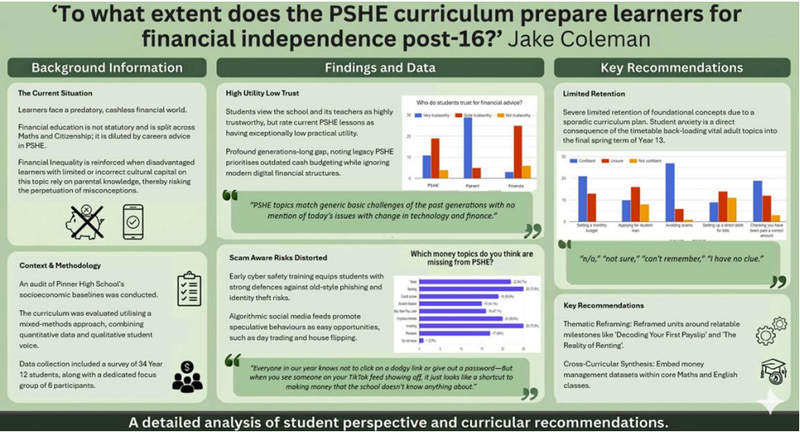
This practitioner enquiry evaluates the effectiveness of the secondary Personal, Social, Health and Economic (PSHE) curriculum in equipping young people for contemporary financial autonomy. Conducted during a teaching placement at Pinner High School, the small-scale study utilises a mixed-methods design—triangulating a digital questionnaire from 34 Year 12 business and computer science students with qualitative insights from a structured focus group. The rationale for this research stems from a critical concern regarding the modern economic landscape; as the UK shifts rapidly into a cashless society, young adults are increasingly thrust into a complex and predatory financial ecosystem featuring neobanks, cryptocurrencies, and deceptive "Buy Now Pay Later" (BNPL) platforms. Despite these dynamic digital challenges, formal financial education remains non-statutory and heavily diluted within the national curriculum. The enquiry’s findings reveal a stark paradox between high institutional trust and low practical utility. While sixth-form students view their teachers as highly trustworthy sources of information, they report that current PSHE lessons lack real-world relevance, struggling to impact their actual consumer decision-making. Instead, learners heavily rely on parental guidance, which inherently reinforces socioeconomic inequality by leaving disadvantaged pupils without the structural "cultural capital" required to navigate complex personal finances. Furthermore, the study identifies a profound generation gap in current resources; structural curriculum delivery is often backloaded to the end of Year 13 or fragmented into sporadic form-time sessions, resulting in exceptionally poor long-term retention. Crucially, while early digital safeguarding has left students highly confident in spotting traditional phishing scams, algorithmic social media feeds have simultaneously desensitised them to extreme financial hazards. Consequently, many young people demonstrate a dangerously distorted risk appetite, viewing highly speculative practices like day trading and crypto-speculation as normalised shortcuts to wealth. To bridge these systemic gaps, this paper advocates for a thematic restructuring of the curriculum around tangible, fast-approaching milestones—such as renting properties and managing student loans—alongside intentional cross-curricular synthesis with mathematics to build authentic, equitable financial literacy.
Impact
Conducting this practitioner enquiry has profoundly reshaped my pedagogical identity and future approach as a secondary business studies teacher. Moving beyond abstract economic theory, the study highlighted a crucial distinction between students merely accumulating academic definitions and developing true, operational financial literacy for the modern world. Witnessing how easily learners absorb unchecked, highly speculative financial narratives online—viewing extreme risks like day trading or cryptocurrency speculation as viable shortcuts—has made it clear that financial education is a vital safeguarding issue. As I transition into full-time teaching, I am committed to moving past legacy, cash-based budgeting models that feel entirely disconnected from a digital, cashless reality. Instead, I will consciously design learning resources that actively counter predatory financial products and social media misinformation, ensuring that my classroom functions as an equitable space where financial literacy is explicitly taught rather than left to chance or home background. Furthermore, the insights gained into student engagement and cognitive load will directly dictate my curriculum planning and classroom delivery. The enquiry exposed the structural flaws of treating personal finance as a non-examined, sporadic afterthought, which directly leads to minimal knowledge retention among learners. To combat this, I intend to leverage the natural cross-curricular intersections between business education, citizenship, and mathematics. I will explicitly reframe personal finance modules around tangible, imminent milestones that resonate with young people—such as decoding a first payslip, evaluating student finance, and navigating the reality of renting. By replacing passive delivery with practical diagnostic tasks, independent group research, and collaborative presentations, I can mitigate teacher workload while fostering meaningful peer learning. Ultimately, this research has taught me to elevate authentic pupil voice, ensuring that my future business education curriculum is dynamic, responsive, and robustly equips every young person with the critical scepticism and financial capability required for life after school.
Additional information