
Back to the Hive or Ready to Fly? Pupil experiences of Reintegration from a SEND Nurture Provision into Mainstream Schooling
Who
- Researcher
- Ciaran Rees
- Degree
- PGT
- Programme
- PGCE Secondary
- Keywords
-
Education Inclusion Mainstream Secondary Special Educational Needs and Disability (SEND) Students
- Methods
-
Qualitative
- Categories
-
Education & language
Summary
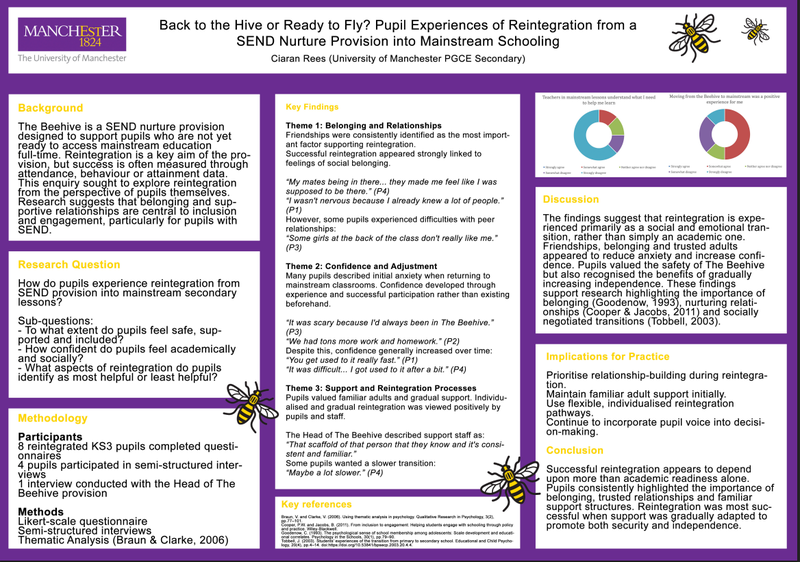
This project explored how pupils experience reintegration from a SEND provision called “The Beehive” into mainstream secondary classrooms. The focus developed from experience within the provision, which supports pupils who are not currently ready to access mainstream education full time and aims to help them reintegrate where appropriate. While reintegration is often evaluated through attendance, behaviour or attainment, this enquiry instead aimed to understand whether pupils themselves feel comfortable, supported and confident once they return to mainstream classrooms.
The enquiry aimed to answer the question: How do pupils experience reintegration from SEND provision into mainstream secondary lessons? Sub-questions explored the extent to which pupils feel safe, supported and included, how confident they feel academically and socially, and which aspects of the process they perceive as helpful or unhelpful. A qualitative practitioner enquiry approach was adopted to explore pupils’ experiences through their own perspectives. The study involved eight Key Stage 3 pupils who had previously attended The Beehive provision and had been reintegrated into mainstream lessons. Data were collected through a questionnaire to gain a broad overview of perceptions, followed by semi-structured interviews with four pupils to explore lived experiences in greater depth. An additional interview with the Head of the provision provided contextual understanding of reintegration processes.
Findings were analysed using thematic analysis, identifying three key themes: belonging and relationships, confidence and adjustment to mainstream, and support and reintegration processes. Pupils frequently described friendships as central, with familiar peers helping them feel like they were supposed to be there. Many pupils initially experienced anxiety due to differences such as larger class sizes and increased workload, but reported that “you get used to it really fast” as confidence developed over time. Support structures were also significant. Pupils highlighted the importance of familiar adults, gradual transitions and individualised approaches. However, some pupils expressed a preference for slower reintegration, suggesting that transition speed is not always aligned with readiness.
Overall, the findings suggest that successful reintegration is shaped by a combination of social belonging, growing confidence and carefully managed support structures. The study concludes that reintegration is not solely an academic transition, but a social and emotional process, and recommends prioritising relationships, maintaining support, and adopting flexible, pupil-centred approaches.
Impact
This research addresses a key need within schools supporting pupils with SEND and SEMH: understanding reintegration from the pupil perspective rather than relying solely on measurable outcomes such as attendance or attainment. While schools often invest significant time in planning reintegration, less attention is given to how pupils themselves experience this process. The findings highlight that reintegration is fundamentally a social experience. Pupils prioritised friendships, relationships with staff, and feelings of belonging over academic concerns. This suggests that schools should place greater emphasis on social integration strategies, such as ensuring peer connections and fostering supportive classroom environments.
The study also demonstrates the importance of familiar adults and gradual transitions. Pupils benefited from consistent support during early stages of reintegration, with confidence developing over time as they became more familiar with mainstream expectations. This reinforces the need for structured but flexible reintegration pathways that can be adapted to individual needs rather than following fixed timelines. Importantly, the research reveals that some pupils may feel less supported in mainstream settings, particularly in relation to teachers understanding their needs. This has implications for whole-school practice, including the need for improved communication between specialist provisions and mainstream staff, as well as greater awareness of SEND strategies.
The impact of this study lies in its potential to inform more inclusive reintegration practices. By placing pupil voice at the centre of the conversation, schools can better tailor support to meet individual needs, improving both wellbeing and engagement. Ultimately, I hope that the findings support a shift towards more relational, responsive approaches to inclusion, where successful reintegration is defined not just by presence in the classroom, but by meaningful participation and a sense of belonging.
Additional information
How to cite
- Access the project on Figshare at DOI 10.48420/33407755.
- Click the red Cite button.
- Select the preferred citation style.
- Click the Copy citation hyperlink to copy the generated citation.