
Fostering Anti-Racist Practice in the Primary Classroom
Who
- Researcher
- Abdullah Ahmed
- Degree
- PGT
- Programme
- PGCE Primary Inclusive Educational Practice
- Keywords
-
Anti-racism Inclusion Mainstream Primary
- Methods
-
Qualitative
- Categories
-
Education & language
Summary
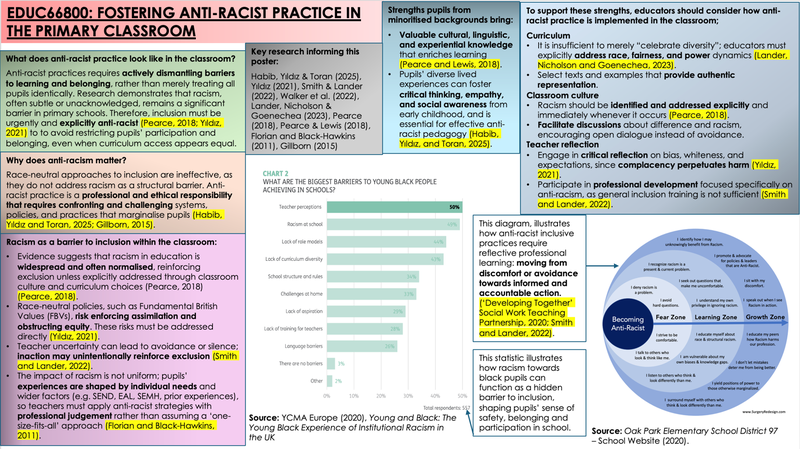
Introduction My chosen focus for the poster is anti-racist practice in primary education as it is a key contemporary challenge for inclusive practice and teacher professionalism. Research indicates that racism continues to act as a barrier to belonging and participation in schools, manifesting through curriculum invisibility and daily interactions, such as microaggressions. My poster explores how anti-racist practice can be integrated into inclusive teaching strategies in the primary classroom. What does Racism look like in Education? The National Curriculum for England (NC) recognises race as a protected characteristic under the Equality Act 2010 (DfE, 2013, p.9), requiring teachers, as part of their wider commitment to equal opportunities, to actively remove barriers to learning and participation. However, this generalised framing often leads to race-neutral approaches being adopted that obscure how racism operates structurally and relationally within schools (Smith and Lander, 2022). As Lander (2014) notes, ‘whiteness’ can operate as the default within school practice, shaping what is considered “neutral” or “professional,” thereby emphasising the need for critical reflection on how power and representation manifest in school life. Anti-racist practice, therefore, is understood as intentional work to recognise and challenge racism in order to support equitable participation and achievement. It is also important to consider how intersecting factors, such as SEND, language proficiency, socio-economic context, and SEMH needs, impact minoritised pupils’ learning experience. This creates a challenge for practitioners, as although research provides frameworks, school leadership and class teachers must proactively adapt their practices accordingly, rather than assume they will yield uniform outcomes. Florian and Linklater (2010) emphasise that inclusion requires professional judgement, not simply the application of techniques, while Yıldız (2021) similarly critiques “race-neutral” discourses that can conceal power dynamics while overlooking race-related barriers to education. Race-Related Barriers to Education One key barrier highlighted in my poster is racial microaggressions, which include subtle acts such as mispronouncing names, stereotyping, setting different expectations, and ignoring the lived experiences of minoritised pupils. Such consistently exclusionary interactions may accumulate over time, undermining pupils’ confidence, participation, and sense of belonging within the school system (Pearce, 2018). As these subtle acts are often dismissed as misunderstandings, they may reinforce the idea that racism is incidental rather than a systemic issue, making it more difficult to challenge in practice. This pattern can best be understood through the hidden curriculum, in which routine school practices implicitly communicate norms about belonging and “acceptable” behaviour (Baykut et al., 2021). These norms align with ‘whiteness’ and can marginalise racially minoritised pupils in the absence of overt discrimination. Smith and Lander (2022) acknowledge that while some teachers may attempt to create localised “pockets of possibility”, they often lack institutional support, which, in turn, sustains racial inequity through everyday classroom interactions. Tokenistic representation and invisibility within the curriculum further act as a significant barrier to inclusion, as, although the curriculum may nominally celebrate diversity, such engagement can remain superficial. Lander, Nicholson, and Goenechea (2023) refer to this as “couscous pedagogy”, whereby multiculturalism is ‘sampled’ and displayed without challenging dominant assumptions about race. Boakye (2022) similarly argues that schooling can appear neutral while operating within a framework of ‘whiteness’, which also paints an unrealistic picture of society for white pupils. This suggests that, without critically engaging with curriculum content, inclusion risks remaining symbolic rather than transformative. Thus, genuine anti-racist practice requires an explicit commitment to racial justice (Walker et al., 2022). Policy frameworks also significantly shape the nature of anti-racist inclusion. Although schools formally promote anti-racist values, Elton-Chalcraft et al. (2016) identify tensions between teachers’ desire to respond authentically to cultural diversity and the expectation to promote Fundamental British Values (FBVs). This is particularly relevant when inclusion requires engaging with controversial topics about racism. Yıldız (2021) further suggests that these FBV frameworks might encourage an assimilationist approach, positioning equity as compliance with shared values rather than as critical engagement with inequality. Consequently, policy contexts may enable exclusion to be tolerated or normalised, underscoring the importance of interpreting inclusion critically and highlighting its status as a structural barrier that constrains teachers from calling out racism directly (Yıldız and Lander, 2025). Strengths that Pupils from Racially Minoritised Backgrounds Bring to the Classroom My poster discusses the strengths of a culturally diverse cohort, emphasising that acknowledging pupils’ cultural differences and lived experiences fosters inclusion by increasing engagement among minoritised pupils and challenging negative stereotypes about certain communities (Pearce and Lewis, 2018). This approach may include incorporating pupils' viewpoints, using culturally responsive examples, and affirming diverse identities through classroom conversations. Habib, Yıldız, and Toran (2025) highlight that anti-racist pedagogy can begin in early years and primary settings through developmentally suitable conversations that nurture empathy and critical thinking. For pupils who have experienced racism or marginalisation, it may not feel safe to engage in the classroom unless they feel a sense of belonging. During my placement, I noticed opportunities to include pupils’ voices in an RE lesson on upcoming Ramadan festivities. Muslim pupils were invited to discuss the significance of the holy month, actively contributing to learning and challenging generalised representations of religious practice, rather than being treated as mere ‘samples’ of diversity. Thus, their involvement upheld cultural differences as valuable assets for collective learning, with pupils’ backgrounds enhancing the learning experience for all. This approach supported inclusion and, more broadly, demonstrates how a responsive curriculum can turn diversity from a mere symbolic gesture into a meaningful intellectual resource (Pearce and Lewis, 2018). Strategies Supporting Anti-Racist Inclusion My poster addresses how curriculum representation, classroom culture, and reflective professionalism can support anti-racist inclusion. Curriculum representation includes selecting texts that prioritise meaningful inclusion over tokenistic representation (Lander et al., 2023), revising existing learning modules, and ensuring the use of resources that reflect the UK's diversity. Le Grange (2022) similarly argues that decolonising the curriculum requires more than merely ‘throwing in’ diversity; it requires dismantling ‘dominant knowledge traditions’ that can perpetuate racism. However, there are practical limitations to consider, such as teacher workload and pressures on curriculum coverage stemming from statutory expectations and pacing. Sustainable implementation is therefore strongly influenced by organisational priorities and senior leadership (Ainscow et al., 2016), meaning that teacher capacity and feasibility must be considered for sustainable change (EEF, 2023). Thus, curriculum pressures require a leadership-level focus to ensure that commitments to inclusion are not dismissed in the name of accountability. These tensions were evident in practice during my placement, where I saw anti-racist inclusion enacted through curriculum coverage. I observed a music lesson planned to address anti-racist inclusion, focusing on West African musical traditions. At the suggestion of a Ghanaian pupil, the lesson explored Ghanaian culture through djembe rhythms and folk songs, enabling pupils to engage with traditions beyond the Eurocentric curriculum. The Ghanaian pupil contributed significantly to the learning experience as a constructor of knowledge, suggesting that recognising and valuing pupils’ contributions enhances inclusive education and participation (Florian and Black-Hawkins, 2011; Adderley et al., 2015). This suggests that teachers can create a more diverse learning experience for the whole class by challenging narrow representations of culture in the curriculum and integrating pupils’ cultural knowledge. Schools can also foster a genuinely anti-racist classroom culture. Pearce (2018) argues that silence about racism can signal acceptance and imply that it is an exceptional rather than a systemic issue. Therefore, teachers have a professional responsibility to ensure that a respectful dialogue is established in their classrooms. For example, during my SE1 Placement, I observed PSHE discussions about diversity and fairness in which behaviour expectations were linked to respect and equity. I also witnessed racist language being explicitly addressed in both class and assembly, emphasising that discrimination would not be tolerated. This reinforces the need to respond explicitly to such incidents, as avoiding them allows racism to go unchallenged (Smith and Lander, 2022). This disrupts the normalisation of racism and reinforces inclusion as a collective responsibility rather than an individual concern. Finally, sustained anti-racist practice relies on reflective professionalism at both the individual and whole-school levels. This requires educators to examine how expectations and pedagogical decisions affect different pupils’ experiences, rather than assuming that neutral practice results in equitable outcomes (Pollard, 2019). Similarly, Smith and Lander (2022) argue that implementing anti-racist practice is an ongoing process that requires critical self-reflection. Therefore, reflective professionalism encompasses ongoing evaluation of classroom norms and patterns of representation and participation to ensure that inclusion is enacted deliberately. Overall, my poster presents anti-racist practice as essential to inclusive education, as it addresses barriers to participation and belonging that can go unchallenged, while recognising that strategies must be adapted for individual pupils within complex classroom and school settings. Conclusion My poster discussion further extended my understanding of inclusion by emphasising racism as a significant barrier. Minoritised pupils’ participation and belonging within school can be subtly restricted through tokenistic representation within the curriculum and ineffective policy guidance, even within seemingly inclusive environments. Meanwhile, I emphasise that pupils’ cultural identities are strengths that enrich the collective learning experience when meaningfully recognised within the curriculum. Anti-racist practice is therefore not peripheral to inclusive practice but an integral part of it.
Impact
As I approach my SE2 placement, I aim to deepen my professional understanding by staying up to date with emerging research and refining my own practice. For example, by adapting my teaching spontaneously during lessons after conducting formative assessments, I can ensure that appropriate scaffolding is in place so that pupils can access age-appropriate learning without lowering expectations. I will also ensure that my lesson planning is grounded in QFT, that it extends OAPs rather than segregating or excluding learners from the rest of the class, and that I can assess how my teaching affects each pupil’s participation, confidence, and progress. Overall, my analysis demonstrates that inclusion practices depend on ongoing professional judgment and critical self-reflection, reinforcing my responsibility as a teacher to actively cultivate a classroom environment that enables equitable participation for all pupils.
Additional information
How to cite
- Access the project on Figshare at DOI 10.48420/33288846.
- Click the red Cite button.
- Select the preferred citation style.
- Click the Copy citation hyperlink to copy the generated citation.