
Racism within the classroom
Who
- Researcher
- Brittanya Whitehead
- Degree
- PGT
- Programme
- PGCE Primary Inclusive Educational Practice
- Keywords
-
Anti-racism Inclusion Primary
- Methods
-
Qualitative
- Categories
-
Education & language
Summary
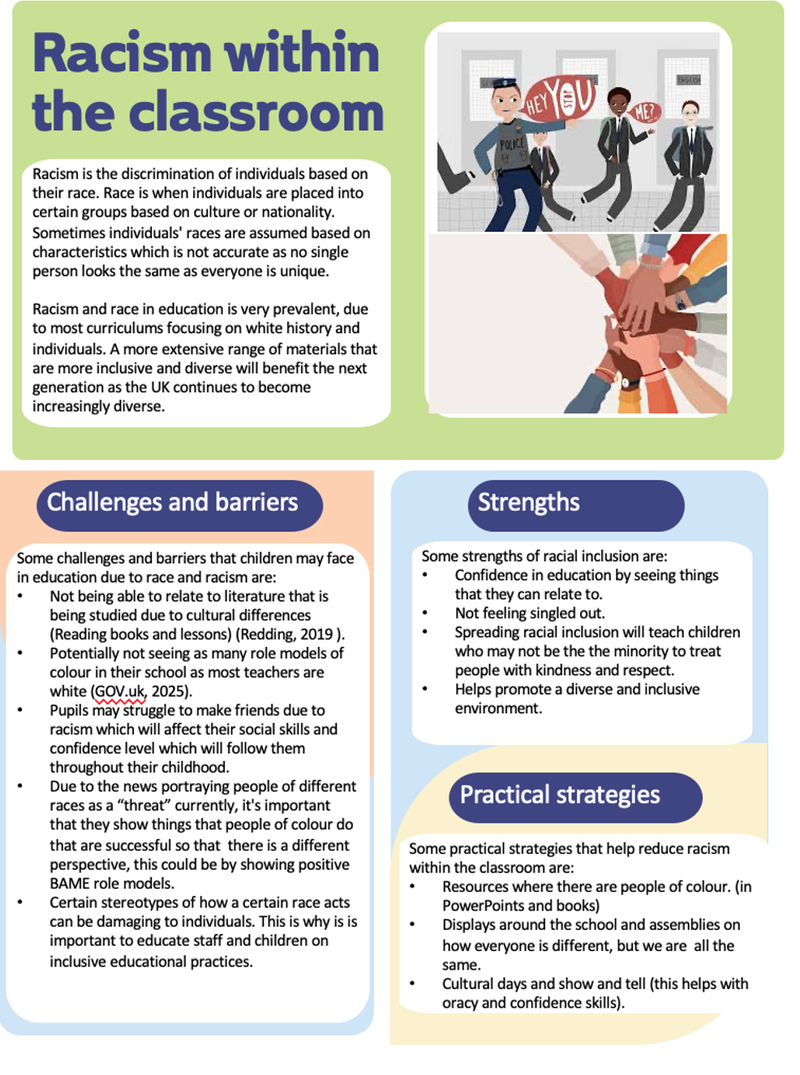
Summary The focus of this assignment and poster is race and racism within the classroom and how including strategies that include different races can result in less racism. Inclusivity within primary education refers to ensuring that every pupil feels like they belong in the classroom (Farid et al., 2024). I have a professional interest in race and racism within primary schools as Greater Manchester is an extremely ethnically diverse county in England. It is extremely prevalent that there will be several different cultures and races within a single classroom with 38% of pupils being from a minority ethnic background, it is important to celebrate all of them to promote inclusivity (GOV.uk, 2025). It is important to recognise that different strategies must be implemented within the curriculum for inclusivity to be achieved for pupils from multicultural backgrounds for them to feel included and even confident within the classroom. The upcoming section of this assignment will be focusing on how inclusivity can be achieved in the classroom using the national curriculum and practical strategies, initially discussing the contents of the poster. Discussion of poster My poster draws attention to racism within the primary school classroom and the different strategies that can be implemented into the national curriculum by teachers and members of staff to ensure that all children are feeling confident and respected. The strategies that are presented aim to reduce the challenges and barriers that pupils may face due to racism. Racism is a social system that organises people into different groups that are referred to as races, this can be based on ethnicity and nationality (Williams, Lawrence and Davis, 2019). Racism does not always directly discriminate an individual. It can be discrimination that is embedded and subconsciously maintained through the curriculum and certain stereotypes. From an early age children begin to recognise that there are different races, whether this being from different children in the classroom or from a television show (Priest et al., 2014). It is important that race is discussed so that it is embraced within the classroom and not seen as a sensitive topic (Boutte, Lopez-Robertson and Powers-Costello, 2011). In a county as diverse as Greater Manchester there are several different challenges and barriers that may affect a pupils learning within the classroom. An example of a barrier is that they may not feel a sense of belonging in the classroom due to all of the resources being targeted at white British pupils. Having resources such as PowerPoints displaying characters of a different colour and with names that may not be your typical traditional British names leads to higher engagement from pupils from an ethnic minority background, as studies have shown that children respond more to literature that they can relate to (Cartledge et al., 2015). Furthermore, having literature displayed around the school focusing on different types of families and cultures is extremely beneficial as this has been proven to have more children participating in reading. Only approximately 7% of books in a primary school contain a BAME character whilst 38% of pupils in primary schools are BAME, this illustrates that BAME students are severely underrepresented in literature in the school (Centre for literacy in primary education, 2018). In addition to this research, during my placement experience it was observed that there was an overwhelming response from BAME students from seeing characters during their White Rose Maths lessons who were also BAME and learning about different significant people such as Rosa Parks, Ghandi and Martin Luther King Jr. This highlights that aspects of the national curriculum can be tailored to being more racially inclusive by using simple, yet effective, resources to make children feel more welcomed in education. Alongside this, another challenge of racism within primary schools is that with social media becoming more prevalent, especially key stage 2, the pupils are susceptible to reading misinformation about certain races online. In the current climate of the media constantly pouring out information on certain races and politics, it is possible that children have heard hateful stereotypes and may share these with other pupils in the classroom. This could lead to an unwelcoming environment and negative racial attitudes being developed (Ward and Bridgewater, 2023). An effective strategy to address this would be to have PSHE lessons focusing on being respectful of different cultures and that everyone is different. Additionally, including British black Asian and ethnic minority history not just focusing on statutory topics but going beyond (Asare et al., 2020). An additional barrier pupils may face within the classroom due to them being of a different race is that they may not see many staff members who look like them. Approximately 17% of teachers in England are BAME and 55% of schools reported that they have no BAME teachers in their schools (GOV.uk, 2025). Research has shown that BAME students, especially black students, perform better academically when they have a teacher who is of the same race (Redding, 2019). This ultimately shows that research correlates teachers and students being of the same race to have a positive effect on their education then it is to be perceived that white British pupils are at an advantage as 83% of the time they have a teacher that is of the same race as them and teaching content that the national curriculum has tailored for them. One strategy to promote racial inclusion in a school where there is no BAME staff is by inviting BAME authors to schools to read their literature or by inviting BAME athletes. This shows BAME students that there are BAME role models and that some of the role models have even wrote a book that they have been reading in class. Racial inclusion is extremely important within the classroom as it promotes diversity and an inclusive environment for all pupils. This can be encouraged through several different practical strategies such as culture days, assemblies, show and tell and PSHE lessons. Research indicates that having immersive cultural experiences benefits children from all ethnic backgrounds as it develops cultural awareness and respect for all individuals (Mahan and Rains, 1990). An activity such as show and tell can be implemented effectively into the classroom by asking pupils to bring in different objects that represent their culture to discuss and share with the class. This activity not only shares cultures with the class but also helps develop confidence and oracy skills as pupils will be standing at the front of the class and engaging in public speaking (Mercer and Dawes, 2024). Culture days, assemblies and display boards are practical strategies that can be put in place across a primary school and are not specific to any key stage.
Impact
To summarise, inclusive education is ensuring that every pupil has the opportunity to learn regardless of their background, race, learning ability, gender, sexual orientation or race. My chosen focus on race and racism within the primary school classroom has highlighted that there are many different barriers that BAME students encounter regularly, whether it being not having any resources or staff members that they can relate to or by facing discrimination from other pupils. A strategy to approach this is by making BAME literature and history easily accessible and showing them black and Asian minorities in high profile jobs, not only to BAME pupils but to all pupils in the school. Ensuring that all pupils are supported through their time in education with all the resources and equipment they need is essential in practicing inclusive education. I intend to develop my professional understanding of how to ensure that equity of access to the curriculum is possible for all learners through my planning and different pedagogical approaches so that my lessons are accessible to all. This may be through using BAME characters on my PowerPoints or by using more scaffolding.
Additional information
How to cite
- Access the project on Figshare at DOI 10.48420/33288849.
- Click the red Cite button.
- Select the preferred citation style.
- Click the Copy citation hyperlink to copy the generated citation.