
Supporting ethnic minority pupils through anti-racist practice in the primary classroom
Who
- Researcher
- Kahlia Brackett
- Degree
- PGT
- Programme
- PGCE Primary Inclusive Educational Practice
- Keywords
-
Anti-racism Ethnic minority Inclusion Primary Student
- Methods
-
Qualitative
- Categories
-
Education & language
Summary
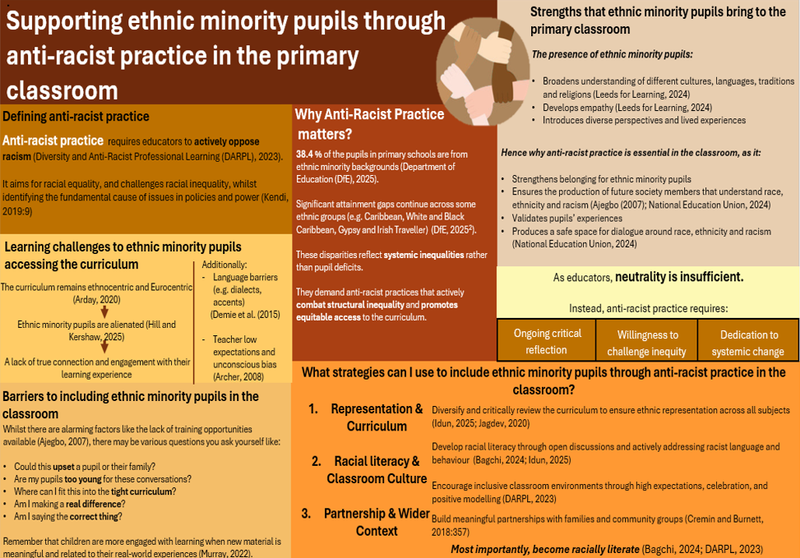
My poster focuses on supporting ethnic minority pupils (EMP) through anti-racist practice in the primary classroom. As a Black Caribbean girl, I sometimes felt alienated during my primary education through various factors like the Eurocentric curriculum and a lack of staff that looked like me. This motivates my professional interest in assisting teachers in creating classrooms where EMP feel supported, respected and respected. The poster illustrates barriers, strengths and strategies for supporting EMP in the primary classroom, analysed through an anti-racism lens. In England, individuals of an ethnic minority background are defined as those who identify as non-White British (Ethnicity facts and figures, 2024). The 2021 Census identifies 19 ethnic minority groups across the categories of Asian, Black, Mixed and White within England and Wales (Office for National Statistics, 2022). Despite this diversity, many of these communities are subjected to racism (Amnesty, 2024). Therefore, primary classrooms must actively embed anti-racist practice, which is the deliberate opposition to racism to ensure racial equality in classrooms, schools and wider society (Diversity and Anti-Racist Professional Learning (DARPL), 2023; Kendi, 2019, p9). This is particularly significant in primary education as children begin to form understandings of fairness, identity and difference. For this reason, I utilised a skin tone colour palette to visually represent the racial diversity of pupils and societal members in England and to challenge the normative positioning of Whiteness within educational environments. By equally centring multiple skin tones, the design reflects the poster’s emphasis on ARP to validate the diverse identities within primary teaching spaces and wider society. Thus, by promoting anti-racist practice, this poster aspires to increase awareness of ethnic minority groups and racism in the primary classroom. Additionally, it will educate teachers, teaching assistants, senior leadership teams and other aspiring teachers about the strengths, barriers and strategies to successfully accommodate ethnic minority pupils. Barriers Ethnic minority pupils face various obstacles in the classroom, however, the Eurocentrism of the education system remains a significant barrier. Arday (2020) argues that the schooling organisation in the United Kingdom has long focused on a dominating White, Eurocentric curriculum that marginalises the contributions of ethnic minority histories. This reflects what Ladson-Billings (2004:51) conceptualises as Whiteness - the positioning of White cultural norms as standard and universal. Consequently, despite being in a multicultural society, ethnic minority pupils experience alienation and reduced engagement as their identities are absent from the curriculum (Hill and Kershaw, 2025). Ayoub (2025: 300) illustrates this through an example of an Arab Muslim girl who wrote a tale about ‘a blonde-haired, blue-eyed teenager’ because she believed this aligned with her teacher’s expectations. This demonstrates that pupil individuality can become omitted and that pupils’ perceptions of whose identities are academically valued can be influenced by curricula norms. In contrast, during placement I observed the enthusiasm of a Year 2 Ghanaian pupil who deeply engaged with the content when she was able to discuss her cultural heritage, highlighting the positive connection between representation and belonging in the primary classroom (Murray, 2022). Beyond curriculum content, additional barriers include language challenges, low teacher expectations and unconscious bias. Educators may also experience uncertainty in implementing anti-racist practice in their classroom based on the fear of getting it wrong, which is detailed on the poster. This was expressed by various teachers on placement and exposes the necessity for persistent training and institutional support to reduce the limit on meaningful inclusion. Strengths Despite the barriers that ethnic minority pupils may face, it is important to recognise and celebrate their strengths. The Leeds for Learning (2024) anti-racist practice guidance highlights that EMP enrich the classroom with diverse cultures, languages and religious perspectives, whilst also fostering empathy amongst peers through collaborative learning. This aligns with Yosso’s (2005) concept of community cultural wealth, which acknowledges the linguistic, social and aspirational capital found amongst marginalised communities, such as ethnic minorities. As anti-racist practice affirms these forms of capital, it strengthens pupils’ sense of belonging by recognising their identities and life experiences. Furthermore, embedding anti-racist practice can create a safe space for open discussions around race, ethnicity and racism. Such dialogue can strengthen pupil voice and confidence when engaging with the societal issues, while encouraging the growth of racial literacy by providing age-appropriate explanation and constructively addressing misconceptions. In doing so, primary learning spaces will contribute to the formation of future citizens who are socially conscious and critical thinkers. However, while the Leeds for Learning (2024) guidance is valuable in encouraging inclusive practices in the classroom, there appears be limited empirical evidence that specifically measures these findings in the classroom. Much of the literature available focuses on addressing attainment gaps and structural disadvantage of ethnic minority pupils rather than demonstrating the benefits they can bring to the classroom. This suggests the requirement for further research to be conducted around ethnic minority pupils that moves beyond the deficit narrative and towards the positive contributions of ethnic minority pupils in the classroom. Without a strong body of research, educators may continue to focus on the deficits rather than acknowledging the social and cognitive contributions that ethnic minority pupils make to the learning environment. Strategies Effectively supporting ethnic minority pupils in the primary classroom requires teachers to understand how race, ethnicity and racism affect learning. For example, addressing racist language or behaviour as it arises demonstrates that discrimination is unacceptable and models fairness (Idun, 2025). Additionally, lessons that display a diverse range of histories, perspectives and contributions help pupils to see themselves and others represented, whilst the identification and celebration of cultural and religious events can deepen respect and understanding in the class. For instance, during placement, I taught a religious education lesson on how Christmas is celebrated in countries around the world. This deeply engaged ethnic minority pupils as they actively contributed to discussions, demonstrating increased engagement and confidence compared to lesson without culturally relevant content. However, these practices are most valuable when educators are racially literate. Joseph-Salisbury (2020) describes racial literacy as the ability to understand how racism and race operate in society, and, more crucially, to apply that knowledge in practice, Rabiger (2025) argues that it is essential for teaching equitably and safely. Smith (2021) notes that there is no reference to race or racism in the Initial Teacher Training (ITT) Core Content Framework, and analysis of the recent ITT and Early Career Framework document similarly reveals this absence (DfE, 2019; DfE, 2024). Such gaps suggest that early career teachers may not receive the preparation to embed anti-racist practice in their classrooms. Unfortunately, until this gap is addressed, many teachers will be unable to establish these strategies within their primary classrooms.
Impact
I have analysed what creating an inclusive primary classroom requires, based on strategies to support ethnic minority pupils through anti-racist practice in the primary classroom. My perspective has developed through identifying the anxiety that many teachers face around race due to limited training and guidance. This has reinforced for me the importance of professional development and open discussions to confidently implement anti-racist practice. Instead of being impartial, IEP must challenge systemic barriers. As I struggled with adaptive teaching in my last placement, this assignment has strengthened both my theoretical understanding and practical awareness of inclusive strategies. On my next placement, I will aim to seek focused mentor feedback, whilst continuing to reflect on my practice as I understand that feedback only becomes impactful when evaluated and applied. I also will preserve when strategies are not immediately successful and adapt them until pupils demonstrate confidence, progress and engagement. Additionally, I will prioritise creating a classroom culture of belonging by modelling positive relationships with each pupil, celebrating their individuality and valuing their culture. Therefore, the pupil will not only have intellectual success but also feel socially and emotionally included. Viewing teaching through an equity lens enables the removal of barriers that prevent a successful educational journey. Through the maintenance of high expectations and adaptive teaching, I can enhance the learning outcomes of each pupil. As a Black Caribbean woman, who has experienced feelings of alienation in her primary classroom, I am committed to ensure that no pupil in my class will feel marginalised. Instead, they will learn in an inclusive, equitable environment where they are respected and empowered to succeed.
Additional information
How to cite
- Access the project on Figshare at DOI 10.48420/33288852.
- Click the red Cite button.
- Select the preferred citation style.
- Click the Copy citation hyperlink to copy the generated citation.