
Supporting children who may experience racism in the primary classroom
Who
- Researcher
- Njahira Waiganjo
- Degree
- PGT
- Programme
- PGCE Primary Inclusive Educational Practice
- Keywords
-
Inclusion Mainstream Primary Student
- Methods
-
Qualitative
- Categories
-
Education & language
Summary
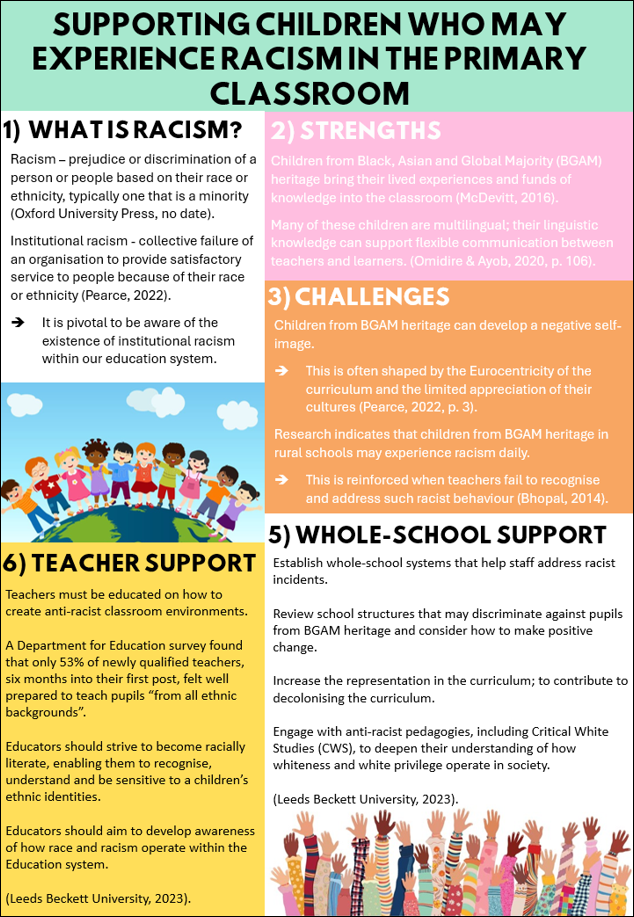
This assignment focuses on the impact of race and racism in the primary classroom, considering how to support pupils from Black, Asian and Global Majority (BAGM) heritage and create anti-racist learning environments. I use the term Global Majority/ BAGM rather than Black, Asian and Minority Ethnic (BAME), as BAME positions people as minorities, whereas Global Majority more accurately reflects that most of the world’s population is non-White (Campbell-Stephens, 2021). My rationale for choosing this focus is partly shaped by my own experience as a person of colour, which informs my empathy for children of colour in the classroom and beyond. I am also passionate about challenging racism in education, and I believe it is essential for teachers to develop anti-racist practices so that all children are supported in ways that meet their individual needs. I will begin by discussing the content of my poster, then move on to a broader discussion and literature review of inclusive educational practices, before concluding with a reflection on how I can apply what I have learned into future practice. Defining racism Racism refers to prejudice or discrimination of people based on their ethnicity (Oxford University Press, no date). Macpherson (1999) defines institutional racism as “the collective failure of an organisation to provide an appropriate and professional service to people because of their colour, culture or ethnic origin”. Such discrimination can occur in subtle ways, including through ignorance, thoughtlessness, racist stereotyping and subconscious bias (Pearce, 2022). The subtle nature of these behaviours can make them difficult to challenge, however, such issues must be addressed, since a pattern of un-challenged indifference can reinforce institutional racism (Pearce, 2022). My own experience as a GCSE pupil reflects how institutional racism can emerge through limited representation in the curriculum. Only one of the fifteen poems in my English Literature anthology was written by a Black author (Maguire, no date). It was also the only text I felt a personal connection to. I realised that I relied heavily on this poem to produce a meaningful comparative piece, highlighting how a lack of representation can restrict opportunities for people of colour. Strengths that children from BAGM heritage bring to the classroom Children from BAGM heritage bring unique funds of knowledge and lived experiences to the classroom (McDevitt, 2016). When teachers adapt the curriculum to reflect and value these experiences, children can access learning in more meaningful and engaging ways. While this additional work may present challenges, the benefits are far greater. Teaching that incorporates a wide range of cultural perspectives not only supports BGAM pupils but also enriches and broadens the perspectives and learning of every child in the classroom. Children from BAGM heritage are often multilingual, creating opportunities for richer linguistic interactions in the classroom (Omidire & Ayob, 2020, p. 106). When teachers have some knowledge of a child’s home language, they can use this to their strengthen relationships with pupils and families (Coady et al., 2016). This highlights the importance of varied communication between all members of the classroom community. The presence of children from BAGM heritage in a classroom can enrich the overall classroom experience. Juvonen, Kogachi and Graham (2018) found that pupils in highly ethnically diverse schools reported feeling safer and less lonely, and teachers were more likely to treat children from all ethnic groups equitably. They suggest that having more evenly sized ethnic groups can be protective, reducing the likelihood of a power dynamic (Juvonen, Kogachi & Graham, 2018). While this is promising in theory, achieving such power balance in practice is challenging, because institutional racism is shaped by the naturalisation of whiteness as the norm, with all other ethnicities positioned as ‘other’ (Leeds Beckett University, 2023). A diverse classroom alone cannot eliminate the impact of structural inequality. Challenges that children from BAGM heritage face in the classroom Children from BAGM heritage can develop a negative self-image, as a result of the curriculum’s lack of cultural appreciation (Pearce, 2022). These children can also experience racism, and its effects are often exacerbated by a lack of teacher willingness to recognise and address issues (Bhopal, 2014). Ultimately, the Eurocentricity of our society leads to children from BAGM heritage being marginalised and positioned as ‘other’, impacting upon how they view themselves and how they are perceived by dominant White others. In September 2019, a 10-year-old Black mixed-race boy attempted to end his life following persistent racist bullying from peers; his mother stated that his teachers and the school failed to protect him (Joseph Salisbury, 2020). The fact that a child so young could experience such distress illustrates the severity of this issue and the urgency with which it should be addressed. How teachers and schools can support children from BGAM heritage As aforementioned, children from BAGM heritage may be perceived by themselves and others as ‘less than’. One way to counter this is through decolonising the curriculum, ensuring that pupils learn about contributions of people from a range of ethnic backgrounds (Jagdev, 2020). All children should feel represented in the curriculum they are working with. Practically, this involves teachers sourcing and using books, examples and ideas from a range of cultures. I engaged with this during my SE1 placement, when I taught an English module on Stories from Other Cultures, using Handa’s Surprise, which is set in a Kenyan village. This linked to our geography module comparing London and Nairobi. As my Dad is Kenyan, I shared photos of myself and my family in Kenya, to hopefully broaden pupils’ understanding of different ways of life out there. Following this, the children asked questions about my family and they seemed to develop a deeper interest in the topic. Additionally, schools should support teachers to engage with anti-racist pedagogies to develop their awareness of how race shapes experiences within the education system (Leeds Beckett University, 2023). One approach involves engaging with Critical White Studies (CWS), examining how whiteness operates as a structural advantage within a society shaped by white supremacy. This reflective practice can highlight forms of racism that may go unnoticed by those who do not experience them. For instance, participants in a CWS program shared a quote on Facebook about how their race, gender and class studies helped them understand why women of colour experience the United States differently from white men. After this, some participants received negative reactions from family and friends, offering practical insight into how racism and the experiences of people from the Global Majority can be dismissed or denied (Leeds Beckett University, 2023). Another way to support children from BAGM heritage in education is to diversify the teacher workforce. Currently, the workforce is predominantly White, with nearly 92% of state-school teachers in England identifying as White in 2018 (Joseph Salisbury, 2020). Research suggests that increasing the number of teachers from BGAM heritage enables children from BAGM heritage to see people who look like them in successful positions. Having such role models could inspire these children to consider who they can become and what they can achieve, which may in turn improve their attainment levels (Joseph Salisbury, 2020). Boakye (2022) states that if we teach a monochrome curriculum in a monochrome environment, it becomes challenging to conceptualise Black success in education. Having more teachers from BAGM heritage can help to challenge negative stereotypes and ensure White pupils see individuals of all ethnicities in respected and aspirational positions (Joseph Salisbury, 2020). During my SE1 placement, as a Mixed-Race trainee teacher in a predominantly White school, I initially had concerns about how I might be perceived. However, my experience showed me that people were more open than I expected. Classroom discussions about skin colour and culture demonstrated that my presence provided pupils with a meaningful opportunity to learn from someone of BAGM heritage, helping to challenge stereotypes and broaden perspectives.
Impact
This assignment has explored how race and racism impact on children’s experiences in the primary classroom, with a particular focus on children from BAGM heritage. I discussed how limited cultural representation can negatively influence these pupil’s experiences and self-image. I then considered strategies to support children from BAGM heritage, including decolonising the curriculum and diversifying the teacher workforce. While these approaches require systemic change, individual teachers hold responsibility for challenging racism and promoting equity within their classrooms. As I move into my next placement, I will build on this understanding by observing how teachers promote inclusivity and by questioning practices which may disadvantage certain pupils. I will consider whether the school adopts a rights-respecting approach and evaluate how it is implemented practically. Upon observing my mentor’s teaching, I will reflect on which forms of scaffolding I can use most effectively support to my students. Ultimately, inclusive education ensures that all children have the opportunity to succeed academically, while developing essential life skills such as empathy, sociability and care for their communities (Jacobs, 2001). My aim is to create a classroom environment in which every child feels safe, valued and able to succeed.
Additional information
How to cite
- Access the project on Figshare at DOI 10.48420/33288855.
- Click the red Cite button.
- Select the preferred citation style.
- Click the Copy citation hyperlink to copy the generated citation.