
An evaluation of ecopoetry as an ecopedagogy
Who
- Researcher
- Allison Lamont
- Degree
- PGT
- Programme
- MA Education for a Sustainable Environment
- Keywords
-
Education and Language Poetric portraits Secondary Sustainability Teacher
- Methods
-
Qualitative
- Categories
-
Sustainability
Summary
The global call of the United Nations (UNESCO, 2022) considers that education underpins all seventeen sustainable development goals. As a teacher of English in the state secondary school system in UK, I therefore wanted to know how literature could contribute to this universal trajectory in educating for the future. As part of my masters in Educating for a Sustainable Environment, my interdisciplinary dissertation set out to evaluate the potential of poetry as a critical pedagogy for ecological and ethical transformation in practice. Specifically, my research considered how ecopoetry as an ecopedagogy may awaken a critical consciousness necessary for ecocentric transformation (Bryson, 2002). Ecocentrism is a paradigm which recognises humanity’s duty towards nature and intrinsically values all life on earth (Leopold, 1986). By ‘life’, I refer to ecological living-systems. Water is an essential life-system and planetary boundary science reveals that human-induced disturbances of global freshwater flows have exceeded safe levels (Rockstrom, 2024). Water has also inspired poetry for centuries. Sahoo asserts that poetry can: play an important role in reviving our ecological consciousness; intuitively connect us with the natural world; and crucially confront difficult ethical questions about the human role in environmental stewardship (2025). Perhaps by designing a workshop that unites poetry with ecology, I could stimulate a collective effort ‘to think in new ways’ and reorient towards ecocentric thinking (Komatsu, 2020, p. 318). To reflexively evaluate how ecopoetry might foster ecocentric learning in relation to our local river, I set out to answer the following two questions: Can ecopoetry as ecopedagogy cultivate ecocentric orientation? Can ecopoetry as ecopedagogy foster eco-conscious transformation? I designed and facilitated an ecopoetry workshop, on a riverbank, for six women who responded to a public advertisement in the Coquet Valley of Northumberland, England. They were not poets. I introduced three poetic interventions which might foster an ecological consciousness for transformation. These were poetically attuning to the river, altering perspectives with the river, and critically dialoguing about ecopoetry. I chose poetic inquiry as an arts-based qualitative research approach (Faulkner, 2024) as I wanted to draw insights from poetic resonance to examine ecocentric orientations that might emerge through deeply ‘felt’ experiences in ecopoetry. In place of thematic data analysis, six poetic portraits were transcribed to interpret the essence of affective learning experienced by each participant. Resonance focuses on attending to deeply felt affective understandings that vibrate for the learner – not the researcher. Poetic portraiture ethically balances asymmetries of power between what the researcher considers relevant and defers ‘knowing’ to the knower. This provided insights into eco-conscious transformation emerging within the ecopoetry workshop. A poetic portrait exemplar follows:
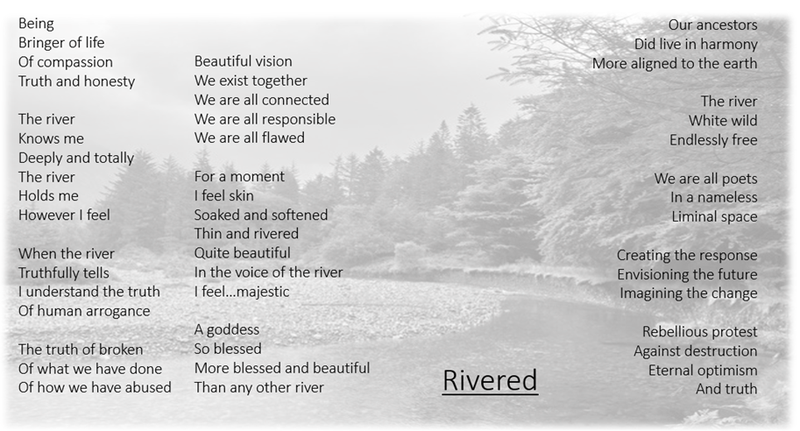
Poetic dialoguing, collective reflection, and adopting the voice of the river, were considered to be the most meaningful ecopedagogical pathways by participants. The six poetic portraits revealed that ecopoetry had cultivated ecocentric orientations manifesting as: ecosystem relationality; eco-conscious transformation; interspecies responsibility; and recognising the river as a living entity. I concluded that when ecocentric learning conditions are authentically optimised in nature, ecopoetry is a powerful pedagogical tool that can shift critical perspectives. Ecopoetry can cultivate ecocentric orientation and foster eco-conscious transformation. Ecopoetry therefore works well as an ecopedagogy that can act for the wellbeing of all planetary life. Both intentional and interventional, this was a design-practice-reflect encounter that applied ecopoetry as a critical pedagogy to shed light on new educational terrain for ecocentric transformation.
Impact
This poetic inquiry revealed that ecopoetry can cultivate ecocentric orientation and foster eco-conscious transformation. Ecopoetry is therefore an important tool for building future resilience in communities. In its capacity to empower multiple stakeholders, it answers the global call for transformation and can be enacted locally: To achieve transformation in our societies, everyone needs to learn how to promote sustainable development: learning needs to happen everywhere and throughout life. To get there, we should work across thematic boundaries and with a wide range of different stakeholders (UNESCO, 2022). Ecopoetry cultivates ecocritical and ecosystems thinking that confronts planetary fragility. More than a pedagogical tool, and stronger than a policy insight, ecopoetry enters our hearts and minds. As a collective ecocritical manoeuvre, ecopoetry can provoke discourse on ‘truths’ that we would rather ignore. What matters is what we choose to do with those deeply uncomfortable dialogues. As a first step for ecopedagogical education, ecopoetry can brings us all closer to an intentionality to act as planetary stewards. The disturbing reality of the eroding health of ‘our’ river had demonstrable emotional impact on participants. Animated discussions translated into inclinations towards collaborative action in community. Ecopoetry therefore has the capacity to unsettle conventional assumptions amongst responsible citizens and stimulate ecoliterate discourse that asks us all to question our human contribution towards failing earth-systems. This can inspire grassroots activism, community-based ecological initiatives and cultural shifts that may instigate policy change from ecocentric values emerging in place. Ecopoetry functions as a powerful interdisciplinary pedagogy. It provides a creative, critical stimulus for ecocentric reorientation that has educational, ecological and ethical merit across the boundaries of art and science and beyond academia. It is universally accessible and has the power to disseminate knowledge in deeply transformative ways. Whilst I hope that the focus of my dissertation might benefit action-researchers contemplating ecocentric praxis with ecopoetry, my personal aim was to gain confidence as a novice facilitator in community to advance educating for sustainability in reality. We are in a crisis of purpose in education. We are currently educating for a world in wrong-relationship with nature. Poetry has always been in relationship with the natural world. This evaluation has uncovered the potential of ecopoetry to educate for ecosystem relationality and eco-conscious transformation. The power of ecopoetry can therefore be mobilized as an ecopedagogy for the survival of all life on earth. Our future resilience, as humans on this planet, requires us to learn earth-centred ways together. A necessary resurgence, requires a shift away from a dominant human-centred education. Ecopoetry can galvanise communities to act for nature.
How to cite
- Access the project on Figshare at DOI 10.48420/33278256.
- Click the red Cite button.
- Select the preferred citation style.
- Click the Copy citation hyperlink to copy the generated citation.